
Blog
The Latest from Our Team

Setting Up User and Password Verification with Cognito
With most solutions, we want to use an IDP (Identity Provider) to manage users. This almost always involves redirecting to a hosted web page to handle user authentication. After the user is authenticated, they are redirected back to our web application. That is a preferred way to handle this problem, mostly because it keeps us…
Read more…

Don’t Panic Labs Announces Seventh Annual Towel Drive for People’s City Mission
Local software product design and engineering company Don’t Panic Labs is excited to announce the return of its annual towel drive for Lincoln’s People’s City Mission. From May 13th to May 26th, Don’t Panic Labs is encouraging all of Lincoln to donate towels of any condition for use at the Mission’s shelter in Lincoln. Towels…
Read more…

Searching Text in C# Using Embeddings with OpenAI
The problem we’re solving today is semantic searching text in C#, using tools provided by OpenAI. A semantic search in this instance refers to searching on the searcher’s intent and the contextual meaning of the query, rather than a simple keyword lookup (for example, search results for “king” may include matches on the word “monarch”)….
Read more…

Using Microsoft CoPilot to Create API Contracts from Other Smaller Contracts
“I choose a lazy person to do a hard job. Because a lazy person will find an easy way to do it.”― Bill Gates Problem We have an established API with a lot of existing functionality. Part of that functionality was the ability to build up requests that could be posted to external APIs for…
Read more…

Challenges Women in STEM are Facing Today
Earlier this month, I attended the Nebraska Women in STEM conference in Omaha, and it was my first time experiencing it. I wanted to share a few thoughts with others regarding the conference. First, seeing so many women in one place was powerful; the second observation I had was that whether it was intentional or…
Read more…

Upgrading a .NET 6 Function App API to .NET 8 Web API
A while ago, we decided to use an Azure Function App as a Web Api. That was when .NET 6 was new. That filter was used to handle some events around the function methods security. Let’s not dwell on if that …
Read more…

Using RabbitMQ with NodeJS
I enjoy trying out different technologies to see what’s new or available. RabbitMQ is one of my recent explorations. In short, RabbitMQ is a free and open source messaging broker. Many cloud providers already have queue solutions, which are easy to work with. But it is always nice to know which options are available if…
Read more…

Visualizing Data in Angular Applications with Chart.js
Charting is something we often do in the software we develop. While it isn’t difficult, it can take more work than you might think. In this blog post, we will create some very simple charts using Chart.js. Assuming we already have an Angular application, we can install Chart.js using npm. npm install chart.js Now let’s…
Read more…

Publishing Azure Functions from JetBrains Rider
You probably shouldn’t deploy straight from JetBrains Rider to an environment within Azure. Doing so might get you into a bad situation, or at least setting yourself up for a bad situation. But there are a couple of scenarios where this might be useful. The first is if you are building a throwaway prototype and…
Read more…
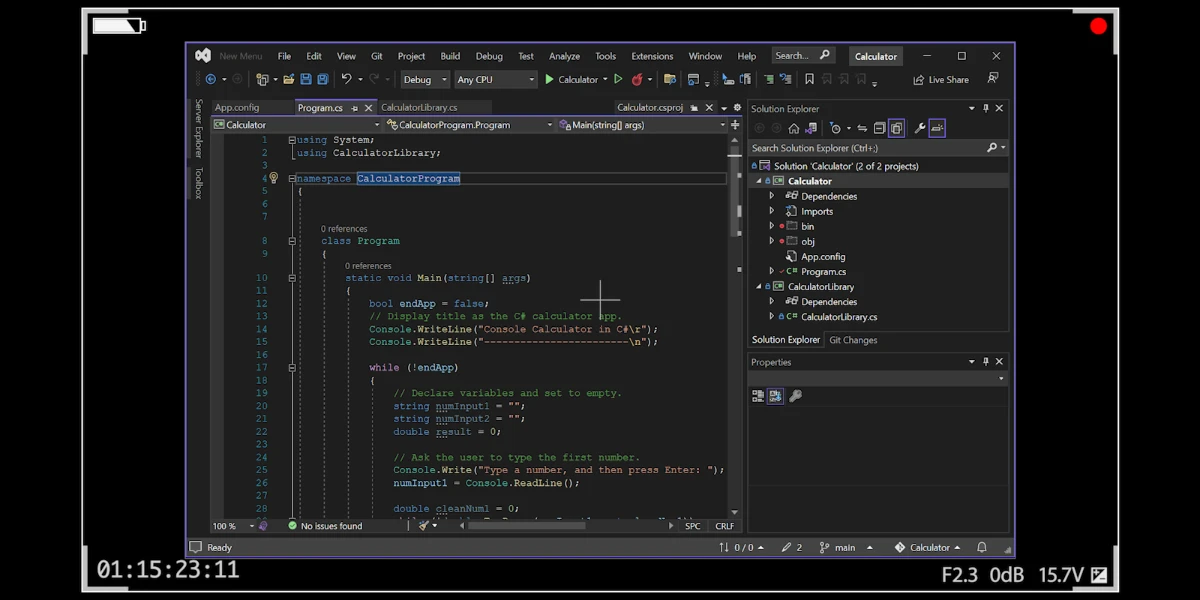
Using Screen Recordings in Your Pull Request Process
With the increasing efficiency demands on today’s developers, the Pull Request (PR) process can benefit from a visual demonstration of the changes. The importance of effective communication, thorough testing, and seamless knowledge transfer becomes increasingly evident. One powerful tool that encapsulates these elements is screen recording. Integrating screen recordings into the PR process is an…
Read more…