
Blog
The Latest from Our Team

CodeBreak: AI-Assisted Development – Part 2
In Part 1 of this series, we used a template to help with our prompting. Ultimately, it generated code for us. But that code wasn’t perfect. It had many small issues. Probably the most annoying was that it often gets import statements wrong. Now, these are super easy to fix, but they still require fixing….
Read more…

You Are a Quantitative Analyst (but Likely Not Very Skilled)
The Hidden Economist in Every Engineer Every time you decide whether to refactor code or push a new feature, you’re doing economics.Software developers and tech leaders make cost-benefit decisions daily, often without realizing it. Should we spend an extra week on automated tests or release now and fix bugs later? That’s a cost-benefit analysis. Do…
Read more…

CodeBreak: AI-Assisted Development – Part 1
AI (Large Language Models, or LLMs) can be helpful in generating code quickly. The problem is that they often don’t generate useful code. To be honest, they often generate erroneous and potentially insecure code. In this blog post, I will show a potential template to use when prompting LLMs that will help get you closer…
Read more…

Don’t Panic Labs Announces Eighth Annual Towel Drive for People’s City Mission
Software product innovation company Don’t Panic Labs is excited to announce the return of its annual towel drive for Lincoln’s People’s City Mission. From May 12th to May 25th, Don’t Panic Labs is encouraging all of Lincoln to donate towels of any condition for use at the Mission’s shelter in Lincoln. Towels are always in…
Read more…

Formatting XML When Serializing C# Objects
Serializing your custom objects in C# is quite simple, and there are several powerful tools at your disposal for crafting the exact XML object you need. Let’s take a look at a few of the ways we can harness the power of C#’s built-in XmlSerializer. Setting Up Your Classes Let’s see how to set up…
Read more…

SAS Style Secure Links: Now with more Bit Shifting!
SAS stands for Shared Access Signature. A SAS style link is a URL that contains parameters needed by the API call as well as a signature that verifies the parameters in the link are correct and haven’t been tampered with. These links can be made to expire, and the key used to create the signature…
Read more…
Don’t Panic Labs – The First 15 Years
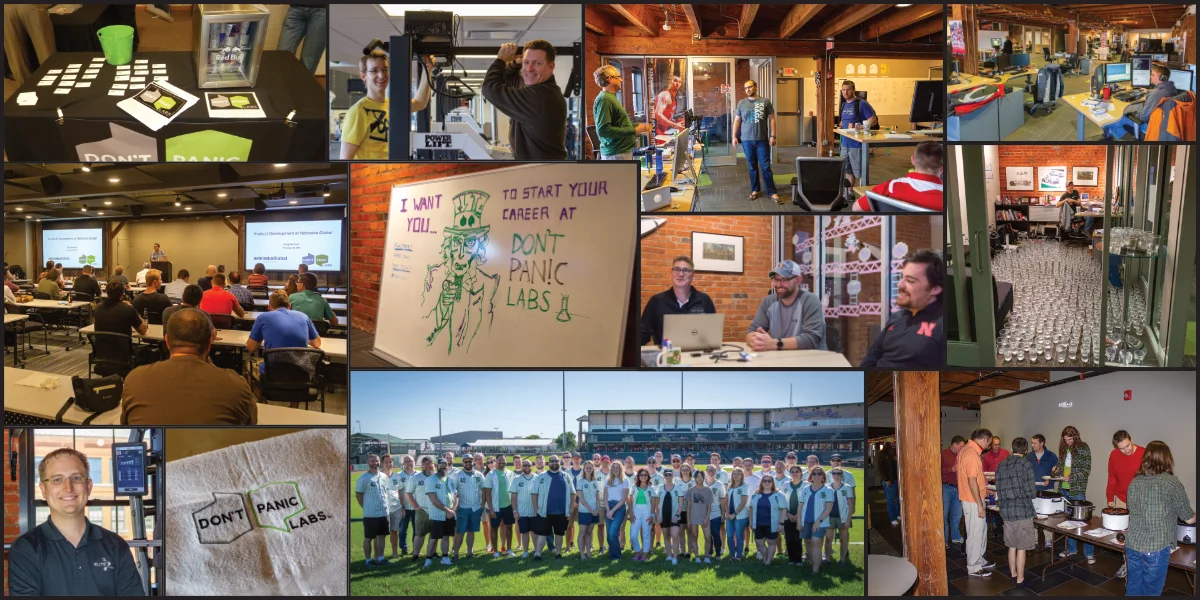
April 2025 marks the 15th anniversary of the founding of Don’t Panic Labs. We are a software product development and innovation company in Nebraska that focuses on providing the necessary support, experience, and product development capacity to innovation groups and entrepreneurs to bring their innovative vision to life. In this blog post, I will be…
Read more…

Coding with AI: How to Get the Results You Actually Want
You can’t talk about software right now without talking about AI or, more accurately, LLMs. These are helping us write software faster. But can they help us be much faster? The common way they help us is by autocompleting code for us. I start writing a method called upsertUser, and then the AI will automatically…
Read more…

Getting Started with Monorepo
In my previous post, I covered my quest to build a shareable component library, using Vue 3. In this post, I will cover taking the current library and turning it into a Monorepo that can handle multiple libraries with Lerna. Prep the Repo To this: Note: You have a package.json file in the root folder…
Read more…

Core Use Cases
In this series, we are focusing on creating a software system. This has many steps. We created a mental model. Next, we got an overview of the project. Then, we gathered requirements and built an epic-level backlog. In this step, we are going to take those artifacts and break them down into core use cases…
Read more…